


11.01.26 15:02 
Declaring and disabling: TNPF neutralises Tamil sovereignty, self-determination & referendum
Declaring and disabling: TNPF neutralises Tamil sovereignty, self-determination & referendum


|
|
Know the Etymology: 19
Place Name of the Day: Thursday, 16 March 2017 Tirukōṇa-malai (Trincomalee), Kīri-malai, Kutirai-malaiதிருகோணமலை, கீரிமலை, குதிரைமலைTirukōṇa-malai, Kīri-malai, Kutirai-malai Tiru+kōṇa+malai Kīri+malai Kutirai+malai The sacred, angular hill The hill/ rocky cliff of Kīri shrubs The horse hill
Malai, meaning a hill or mountain in Tamil, is listed as Dravidian (DED 4742). It has cognates in 12 Dravidian languages, including Brahui of Pakistan. In Sanskrit, Malaya meaning only the Western Ghats of South India, shows the non-IA origins of the word. The root word Mal in Dravidian means fertility and strength, and related verb forms mean, to become large, swell, spread, expand etc. (see box). Mal, Mala and Malē are cognates in Sinhala. As the terrain is hilly, many related place names could be found in the Sinhala regions. See column 156 for usage examples and discussion on the Sinhala cognates. In Eezham Tamil place names, Malai mostly stands for a hillock, cliff, mound, and sometimes even for the highest locality of a place as in Vīra-malai in Puṅkuṭu-tīvu, Katira-malai in Cuṉṉākam and Malaiyaṭi in Nayiṉā-tīvu (see related place names). Kōṇa as adjective meaning angular in Tamil corresponds to the nouns Kōṇ and Kōṇam meaning the same and to the verb Kōnu meaning to be bent or curved. They are listed as Dravidian (DED 2209), as in the case of the other words having the root Kō and meaning curvature or crookedness. Kōṇa in Sanskrit, Prakrit and Pali are traced to Dravidian (CDIAL 3504). See column 80 on Tiru meaning sacred or auspicious. Kīri commonly means a mongoose in Tamil and there is an old myth associating Kīri-malai with the arrival of a mongoose-faced Saiva preceptor (probably a conflation of the term Kīri with the Nakulīśa/ Lakulīśa identity of a Pāśupata preceptor). However, looking at the wide distribution of Kīri-related place names in Eezham Tamil, Kīri in Kīri-malai seems to have come from a kind of a shrub. The Kīri shrub, as it is identified in Eezham Tamil usage, belongs to the species, Pemphis acidula. This is mostly found in the coastal tract. How this shrub got the name is not clear. In Sinhala, another species of a shrub or small tree, Acacia catechu or Mimosa catechu, is called Kīri, and there are Sinhala place names related to this shrub. Kīri also means Kūra (pin, skewer etc.) in Sinhala. This is related to Kūr in Tamil/ Dravidian meaning to be sharp as verb and sharpness or pointedness as noun (DED 1898). Acacia catechu is known for its conspicuous spiny thorns. Kutirai meaning horse in Tamil/ Dravidian (DED 1711) comes from Kuti as a verb meaning to jump or leap and as a noun meaning a jump or leap (DED 1705). As noun, Kuti also means the heel of the foot (DED 1707). Kutirai-malai seems to have come from the horse statues put up at the Aiyaṉar temple located at this place. It is a common folk practice to have life-size terracotta figures of horses at Aiyaṉār temples. The Aiyaṉar worship at this place is noted in the historiographical literatures of Jaffna. Tirukōṇa-malai is a harbour city and district headquarters of its own district called Trincomalee in the Eastern Province. Kīri-malai is in Valikamam North division of Jaffna district. Kutirai-malai is in the Vilpattu forest of Puttalam district (One Inch Sheet). This is a cliff and point along the coast of the Gulf of Mannar. Some related place names: Malai: Kampar-malai: Valvettiththurai, Jaffna (One Inch Sheet) Katirai-malai: also Katira-malai: Katirkāmam, Moneragala; Cuṉṉākam, Jaffna. It is a hill in Katirkāmam and the highest ground in Cuṉṉākam, where the Katirai-malai Civaṉ temple is located. The old name of Kantarōṭai in Cuṉṉākam also was probably Katiramalai. This is also a high ground. Pan-kuḷattu-malai: Kaṭṭukkkuḷampattu, Trincomalee (One Inch Sheet) Nīlap-paṇikkaṉ-malai: Kaṭṭukkkuḷampattu, Trincomalee (One Inch Sheet) Aṭampaṉ-malai: Kaṭṭukkkuḷampattu, Trincomalee (One Inch Sheet) Kūḻāṅ-kallu-malai: Kaṟukkāymuṉai, Trincomalee (One Inch Sheet). Kūḻāṅ-kallu: pebble stone (Tamil, MTL); Kūḻai: smallness (Tamil, Naṟṟiṇai, 109: 8); that which is short (Tamil, DED 1914); Kuṟai: (verb) to diminish, be reduced (Tamil, DED 1851) Vīra-malai: Puṅkuṭu-tīvu, Jaffna (One Inch Sheet). Located in the highest ground in the island Malaiyaṭi: Malai-aṭi: Nayinā-tīvu, Jaffna (One Inch Sheet) Tantiri-malai: Mahawilachchiya, Anuradhapura Ciṉṉa-malai: Toṇṭaimāṉāṟu, Vadamaratchi North, Jaffna (Balasundaram, p. 63). A lime stone mound Periya-malai: Toṇṭaimāṉāṟu, Vadamaratchi North, Jaffna (Balasundaram, p. 63). A lime stone mound Cutu-malai: Valikamam Southwest, Jaffna Iḷa-malai: Vadamaratchy North, Jaffna Otiya-malai: Oddusuddan, Mullaiththeevu. Oti: a tree Taṭṭaiya-malai: Oddusuddan, Mullaiththeevu Taṭṭā-malai: Oddusuddan, Mullaiththeevu Cem-malai: Karaithuraippattu, Mullaiththeevu. Cem: red Kāṭṭut-taṭṭā-malai: Karaithuraippattu, Mullaiththeevu Aṉṉa-malai: Navithanveli, Amparai Nalla-taṇṇi-malai: Irakkamam, Amparai Koṭi-pōṭṭa-malai: Koralaippattu, Batticaloa Kuṭumpi-malai: Koralaippattu, Batticaloa Cūraṉ-kal-malai: Koralaippattu, Batticaloa Pullu-malai: Eravurppattu, Batticaloa Āyittiya-malai: Manmunai West, Batticaloa Kaccak-koṭi-malai: Manmunai South West, Batticaloa. Kaccaṟ-koṭi: a creeper Tāntā-malai: Manmunai Southwest, Batticaloa Malaiyar-kaṭṭu: Poratheevuppattu, Batticaloa Poṉ-malaik-kuṭā: Kuchchaveli, Trincomalee. Poṉ: gold, golden, metal, iron (Tamil, DED 4570) Karu-malai-ūṟṟu: Trincomalee Town and Gravets, Trincomalee. Karu: dark, black Malaiyaṟuttāṉ Kaṭṭai-aṭampaṉ: Malai-aṟuttāṉ-kaṭṭai-aṭampaṉ: Nanaddan, Mannar. Aṟu: (verb) to cut, cleave, exterminate (Tamil, DED 315); Aṟuttān: 1.That which was cut; 2. The place that was cut Malaiyaṭik-kirāmam: Malai-aṭik-kirāmam: Sammanthurai, Amparai Malaiyaṭi Govi-pala: Malai-aṭi Govi-pala: Damana, Ampara Malaiyaṭiya: Malai-aṭi: Damana, Ampara Kīri: (Tamil) Kīri-muṉai: Poṉṉāveḷi, Poonakari, Kilinochchi Kīri-muntal: Kalpitti, Puttalam (One Inch Sheet). Muntal: promontory, projecting point. The place is the tip of the Kaṟpiṭṭi Peninsula Kīrik-kuḷam: Kalpitti, Puttalam Kīrit-tōṇā: Pāla-muṉai, Batticaloa Kīrip-palli: Vadamaratchi, Jaffna. Palli: grazing ground, cattle pen, settlement of cattle herders Kīriyaṭit-tāḻvu: Muruṅkaṉ Southeast, Mannar Kīri-cuṭṭāṉ: Madu, Mannar Kīri: (Sinhala) Kīrik-kuḷama: Nuwaragam Palatha, Anuradhapura Kīri-vala-gama: Kotapola, Matara Kīri-piṭiya: Pasgoda, Matara Kīriya-gas-vẹva: Kekirawa, Anuradhapura Kīri-hēna: Deraniyagala, Kegalle Kutirai: Kutirai-kutti: Nanaddan, Mannar Notes: Tirukōṇamalai/ Trincomalee: Tirukōṇamalai is a rocky, angular hill as well as a cliff facing the sea. The component Kōṇa coming in the place name, obviously from the unique geography of the place, could be seen from the times of the earliest records available. Pali sources note the place name as Goṇa-gāmaka-paṭṭana (note the Paṭṭana suffix corresponding to Paṭṭiṉam meaning a port town in Tamil/ Dravidian). Kōnarak in Odissa in the eastern coast of India is another example for angular places getting the name Kōṇa. Another name found in Pali sources for Tirukōṇamalai is Gōkarṇa or Gōkaṇṇa, which has a parallel in Karnataka in the western coast of India, where there is an ancient Siva temple. Leaving aside the ‘cow’s ear’ myth, there is a probability that this term also was connected to an angular landscape. The place was referred to as Kōṇa-mā-malai (the great angular hill), in connection with a Siva temple there, in the 7th century CE Tēvāram hymn in Tamil. “கோயிலும் சுனையும் கடலுடன் சூழ்ந்த கோண மா மலை அமர்ந்தாரே” (சம்பந்தர் தேவாரம், 3: 123: 5) “Kōyilum cuṉaiyum kaṭaluṭaṉ cūḻnta kōṇa mā malai amarntārē” (Campantar Tēvāram, 3: 123: 5) [God Siva] resides in the great angular hill (Kōṇa-mā-malai), where the temple and the spring are surrounded by the sea The cult of Siva predating the advent of Buddhism in the island is deducible from Mahavamsa noting Muṭa Siva as the personal name of the father of Devanampiya Tissa. Siva coming in a number of personal names in the early Brahmi inscriptions of the island also shows the presence of Saivism in the early historic period. Mahavamsa (XXXVII: 41) notes the destruction of a temple of a god at Gokarṇa (Trincomalee) for the construction of a Vihāra in the times of Mahasēna (274-301 CE). Its commentary (Mahāvamsa-tīkā, 685) says that it was a Sivalinga temple (Indrapala, 2006, p. 226, p. 390). However, a Saiva temple was flourishing at this place in the 7th century CE, as attested by Tēvāram. There is a strong probability that initially a non-Brahmanic early school of Pāśupata Saivism existed at this place. A later text such as the Kōṇēsar Kalveṭṭu remembers Brahmins succeeding the Pāsupatās in the time of king Gajabahu (12th century CE). “பழுதில் புகழ் கயவாகு வருமன்னாட் பாசுபதர் இறப்பர் பழமறையோர் சேர்வர்” (கோணேசர் கல்வெட்டு) “Paḻutil pukaḻ Kayavāku varumaṉṉāṭ Pācupatar iṟappar paḻamaṟaiyōr cērvar” (Kōṇēcar Kalveṭṭu) The day Kayavāku of blemish-less fame visits this place, the Pācupatās would die and the people (Brahmins) of the old Vedas would reach here. In the 16th century, the Portuguese destroyed the temple that existed on the hill at this place. Kīrimalai: Kīrimalai is a limestone cliff of around 50’ in height, facing the Palk Bay. It is the highest point in the flat landscape of Jaffna Peninsula. The historiographical literature of Jaffna associate the place and the freshwater spring there with a hermit and preceptor named Nakula-muṉi. Nakula-muṉi probably was a preceptor following the Pāśupata sect of Saivism of Nakulīśa/ Lakulīsa. The founder of the sect was identified by the term from the staff (Nakula/ Lakula) held by him. The myth that the Nakula-muṉi of Kīrimalai had a mongoose face might have come from a conflation, as the common meaning for Nakula in Sanskrit and Kīri in Tamil is a mongoose. Kīrimalai later became a seat of Vīra Saivism of Kannada connections.  Location of Trincomalee [Based on Google Map]
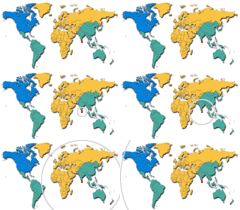
 Inset: Trincomalee [Based on Google Map]
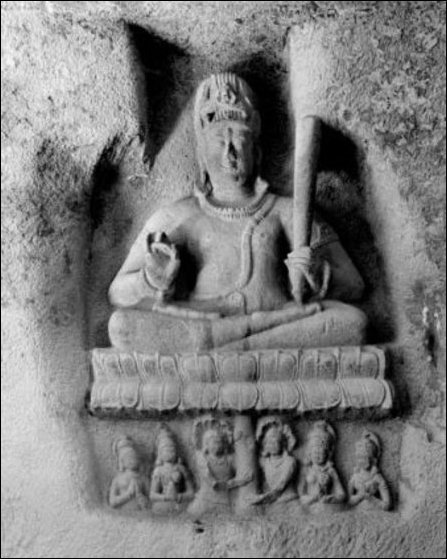 Nakulisa or Lakulisa, Ellora Cave 29
 Nakulisa/Lakulisa, shown with four desciples. Bhubaneswar, Orissa
 Nakulisa/Lakulisa, styled like Buddha. The staff at the left shoulder makes the difference in the iconography. Bhubaneswar, Orissa [Courtesy: Huntington Archive]
 [Courtesy: Société Botanique de France]) Keeri shrub, a coastal vegetaion (Lythrum pemphis or Pemphis acidula) [Courtesy: Société Botanique de France]
 The limestone cliff at Keerimalai
 Kutirai-malai Point [Satellite image courtesy: Google Earth]
 Kutirai-malai Point detail [Satellite image courtesy: Google Earth]
Revised: Thursday, 16 March 2017, 23:20 First published: Sunday, 01 July 2007, 01:00
Previous columns:
|
Latest 15 Reports
|
||||||||||||||
|
Reproduction of this news item is allowed when used without
any alterations to the contents and the source, TamilNet, is mentioned |
||||||||||||||||
|
News | Features | Opinion | Palaka'ni | Photo Features | TN Transcription
Web feeds | Feedback | Home | About us |
 URL: http://www.tamilnet.com