


11.01.26 15:02 
Declaring and disabling: TNPF neutralises Tamil sovereignty, self-determination & referendum
Declaring and disabling: TNPF neutralises Tamil sovereignty, self-determination & referendum


|
|
Know the Etymology: 124
Place Name of the Day: Wednesday, 27 September 2017 Nantik-kaṭal, Kuṟukkuk-kaṭal, Veḷḷaik-kaṭaṟkaraiநந்திக்கடல், குறுக்குக்கடல், வெள்ளைக்கடற்கரைNantik-kaṭal, Kuṟukkuk-kaṭal, Veḷḷaik-kaṭaṟkarai Nantu+kaṭal Kuṟukku+kaṭal Veḷḷai+kaṭal+karai The sea/ lagoon of conches The sea/ lagoon lying across; or the intruding sea/ lagoon The white (sand) beach
Kaṭal and Kaṭaṟ-karai are common Tamil words of Dravidian etymology, meaning sea and seashore respectively. Kaṭal corresponds to the verb Kaṭa meaning to cross and the noun Kaṭai meaning end. Kaṭal meaning ocean, sea: "விரி திரைப் பெருங் கடல் வளைஇய உலகம்" (குறுந்தொகை, 101: 1) "Viri tiraip peruṅ kaṭal vaḷaiiya ulakam" (Kuṟuntokai, 101: 1) The world surrounded by big ocean of moving waves "கடல வெண் திரைப் புணரி ஆடியும்" (குறுந்தொகை, 144: 1-2) "Kaṭala veṇ tiraip puṇari āṭiyum" (Kuṟuntokai, 144: 1-2) Bathing in the white crested waves of the sea [Kaṭal+a > Kaṭala; genitive case] Kaṭaṟkarai meaning seashore: "வேலையும் பாராவாரமும் கடற்கரை" (திவாகரம், 5: 41) "Vēlaiyum pārāvāramum kaṭaṟkarai" (Tivākaram, 5: 41) Vēlai and Pārāvāram means Kaṭaṟkarai (seashore, beach) Nantu is an old Tamil word, meaning conch. A related word Nattai is commonly used in Tamil today to mean snail. Nantu as conch: "நந்தின் பேழ்வாய் ஏற்றை" (அகநானூறு, 246: 1) "Nantiṉ pēḻvāy ēṟṟai" (Akanāṉūṟu, 246: 1) The wide-mouthed male conch "நந்தும் முரளும் ஈர் அறிவினவே" (தொல்காப்பியம், 1528) "Nantum muraḷum īr aṟiviṉavē" (Tolkāppiyam, 1528) Conch and oyster have only two senses, i.e., feeling in body and mouth Nantik-kaṭal is the name of a lagoon in Mullaiththeevu district. Kuṟukkuk-kaṭal is the name of a sea intrusion found near Nārāntaṉai in Kayts division of Jaffna district (Jaffna OIS) Veḷḷaik-kaṭaṟkarai is the name of a beach known for its white stand in Allaippiṭṭi in Kayts division of Jaffna district. Some related place names: Kaṭal: Ciṟu-kaṭal: Karaithuraippattu, Mullaiththeevu Kaṭalūr: Koralaippattu, Batticaloa; Kuchchaveli, Trincomalee Tiruk-kaṭalūr: Trincomalee Town and Gravets, Trincomalee Kaḍal: (Sinhala, place name) Kaḍalāna: Moratuwa, Colombo. Kaḍal+āna: Āna: place (Sorata) Kaṭaṟkarai: Aḷampil-kaṭaṟkarai: Karaithuraippattu, Mullaiththeevu. Aḷampil: a coastal place that has got its name from saltpans Kaṭaṟkaraic-cēṉai: Moothoor, Trincomalee. Cēṉai: shifting cultivation field Notes on conch diving: Diving for conches was an ancient economic activity in the coasts of Tamil Nadu and Ilaṅkai. The Jaffna Lagoon, Nantikkaṭal of Mullaittīvu and the lagoons of Kaṟpiṭṭi, Puttaḻam, Negombo and Batticaloa were known centres of this activity in the island. The type of conch that is of commercial value belongs to the species Turbinella pyrum, which is found only in the waters of Palk Strait and Gulf of Mannar. Howell who studied them in 1916 identifies three sub-species: Turbinella pyrum pyrum, found north of Adams Bridge, i.e., in the waters of Jaffna; Turbinella pyrum rapa Lamarch, found in the south of the Adams Bridge and Turbinella ponderosa found around Kumari Muṉai (Cape Comarin) The archaeological sites on either side of the Palk Strait and the Gulf of Mannar bear extensive evidences for the prevalence of conch craft from very early times. Sawed conch shells, fragments of conch-bangles, heaps of discarded wastes of shells etc. found in large numbers in the sites of Jaffna Peninsula, Māntai in Mannar and Koṟkai - Aḻakaṉ Kuḷam - Atirāmpaṭṭiṉam stretch of the Tamil Nadu side of the Gulf of Mannar and Palk Strait, speak of the popularity of conch craft in this region. Caṅkam literature is another testimony for the antiquity of this craft in Tamil heritage. In the later times after 12th century CE, Bengal, especially Dhaka became the centre for conch craft. The Bengali community of conch craftsmen are believed to be Tamil migrants of the times of the Cholas and later. Even in recent times, conches gathered in the north of Ilaṅkai were exported to Bangladesh, where the shells and ornaments made of them are of great cultural value. For Bengalis and Oriyas, a bangle made of conch shell is somewhat like a Tāli in Tamil culture. Banglapedia, the National Encyclopedia of Bangladesh, records that a particular species of conch available in Jaffna and Titpur in Tamil Nadu constitutes the basic raw material for the conch craft of Bangladesh. 150 conches costing 40 - 45 Tk in 1910, now cost 14,000 - 30,000 Tk, the encyclopedia says. The Jaffna conches are of more value than the Indian conches in the Bangladesh market and one of the complaints of the Bangladesh craftsmen today is scarcity and high price of quality raw material. The conch and pearl divers, whether on the side of Ilaṅkai or on the side of Tamil Nadu, mainly came from two ancient Tamil coastal communities known as Mukkuvar and Paravar. The etymology of the name Mukkuvar is connected to the Tamil word, Mukku or Muk-kuḷittal, which means holding one's breath and diving. Mukkutal and Mūḻkutal (immersing in water) are cognates in Tamil. The name of the other community Paravar comes from another old Tamil word Paravai meaning sea.  Location of Nanthikkadal, the conch-lagoon [Satellite image courtesy: Google Earth]

 Turbinella pyrum pyrum, the type of conch found in the waters north of Adams Bridge, ie. Palk Bay, Jaffna Lagoon, Nanthikkadal etc. [Photo courtesy: Hardy's Internet Guide to Marine Gastropods]
 A matured specimen of Turbinella pyrum pyrum [Photo courtesy: shells.webz.cz]
 Shell bangles of the times of Indus civilization [Photo courtesy: imagesofasia.com]
 Turbinella pyrum and bangles made of it in Bangladesh [Photo courtesy: Banglapedia]
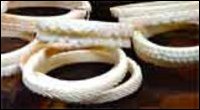 Bangles made of conch shells, West Bengal, India [Photo courtesy: sos-arsenic.net]
 A conch craftsman at work in Dhaka, Bangladesh [Photo courtesy: SOS-arsenic.net]
 Note the shell bangles in the hands of the lady from West Bengal, India [Photo courtesy: flickr.com/tonymitra]
Revised: Thursday, 27 September 2017, 18:30 First published: Friday, 06 March 2009, 05:42
Previous columns:
|
Latest 15 Reports
|
||||||||||
|
Reproduction of this news item is allowed when used without
any alterations to the contents and the source, TamilNet, is mentioned |
||||||||||||
|
News | Features | Opinion | Palaka'ni | Photo Features | TN Transcription
Web feeds | Feedback | Home | About us |
 URL: http://www.tamilnet.com