


11.01.26 15:02 
Declaring and disabling: TNPF neutralises Tamil sovereignty, self-determination & referendum
Declaring and disabling: TNPF neutralises Tamil sovereignty, self-determination & referendum



|
|
Know the Etymology: 196
Place Name of the Day: Friday, 18 March 2011 Nu'naavilநுணாவில்Nuṇāvil Nu’naa+vil The pond of Nu’naa trees
 Nu’naa/ Ve’n-nu’naa, Morinda citrifolia, foliage and fruits [Image courtesy: Wilfredo Rodríguez, en.wikipedia.org]
 Nu’naa/ Ve’n-nu’naa, Morinda citrifolia: Flowering and the way the fruits take shape. Compare the image with the description of the flowers of the Nu’navu tree found in the Changkam Tamil literature Akanaanoo’ru as “Karungkaal nu’navin perugnchinai vaan poo,” meaning the white flowers of big embryo/ ovary of the dark-stemmed Nu’navu tree [Image courtesy: Kazuo Yamasaki, plant-pictures.de]
 Nu’naa/ Ve’n-nu’naa, Morinda citrifolia: cross section of a ripe fruit [Image courtesy: fireflyforest.net]
 Nu’naa/ Magncha’l-nu’naa, Morinda tinctoria photographed in Tamil Nadu [Image courtesy: mooligaivazam-kuppusamy.blogspot.com]
 Nu’naa/ Magncha’l-nu’naa/ Magnchamunnaa, Morinda tinctoria, photographed in Jaffna
 Nu’naa/ Magncha’l-nu’naa/ Magnchamunnaa, Morinda tinctoria: flowers on the fruit that is taking shape, photographed in Jaffna
 Nu’naa/ Magncha’l-nu’naa/ Magnchamunnaa, Morinda tinctoria: Fruit [Image courtesy: shubhada-nikharge, outdoors.webshots.com]
 Morinda pubescens, synonym of Morinda tinctoria: fruits, photographed in Ananthagiri forest, Andhra Pradesh [Image courtesy: commons.wikimedia.org]
 Nu’naa/ Magncha’l-nu’naa/ Magnchamunnaa, Morinda tinctoria: Foliage of a matured tree, photographed in Jaffna
 Custard Apple, Annono reticulata, introduced by the Portuguese and was taken as a variety of Nu’naa by Tamils: Annono-nu’naa > Annamunnaa [Image courtesy: forest.puducherry.gov.in]
The crusted dark stem and the fragrant flowers that make the composite shaped fruit in the Nu’naa tree have found a special mention in the Changkam literature. “கருங்கால் நுணவம் கமழும் பொழுதே” (ஐங்குறுநூறு 342) “Karungkaal nu’navam kamazhum pozhuthea” (When the dark-stemmed Nu’navam blossoms in fragrance; Aingku’runoo’ru 342) “நறவு வாய் உறைக்கும் நாகு முதிர் நுணவத்து அறை வாய்க் குறுந்துணி” (சிறுபாணாற்றுப்படை 51) “Na’ravu vaay u’raikkum naaku muthir nu’navaththu a’rai vaayk ku’run thu’ni” (The small composite beads (fruits) of the matured Nu’naa of mouth-tingling honey; Chi’rupaa’naattuppadai 51) “கருங்கால் நுணவின் பெருஞ்சினை வான் பூ” (அகநானூறு 345:16) “Karungkaal nu’navin perugnchinai vaan poo” (The white flowers that make a big fruit of the dark-stemmed Nu’naa; Akanaanoo’ru 345:16) Nu’naa/ Nu’navu/ Nu’navam seems to be a generic term in Tamil for the trees that bear composite fruits or syncarps, shaped like small beads made into a ball. (See images of the fruits) The Tamil term Nu’nukku of Dravidian etymology (DED 3700) means small particles. Another related term Nu’nangku in Tamil and Malayalam means warts, spots or pimples on body (DED 3701). Nu’nal is an old Tamil word of Changkam diction for a frog, may be because of its body of warts and spots. In parallel, the Sanskrit names for the Nu’naa (Morinda tinctoria/ citrifolia) tree, Aakshika, Aakshakee etc also of a similar etymology coming from the composite shape of its fruits. The Sanskrit names of the tree come from the root Aksha/ Aaksha, meaning seed, eye, etc. The Sinhala name for Nu’naa tree, Ahu or Ahu-gas, is related to the Prakrit forms of the Sanskrit names of the tree. Morinda citrifolia is widely found in the Maldives islands where it is known by the name Ahi-vah or Ahi-vah-kaa. The first part of the Maldivian name Ahi is a cognate of Ahu in Sinhala, related to the Sanskrit/ Prakrit etymology discussed above. The middle component Vah in Maldivian means a ball as well as a single fruit of certain trees (from Va’lai/ Vaddam: Tamil/ DED 5313; Vatta: Sanskrit/ Prakrit). The third component Kaa in Maldivian is related to Kaay in Tamil/ Malayalam for any fruit (DED 1459). Also note that Akki in Eezham Tamil means pimples, skin eruptions etc., related in meaning to Nu’nangku of DED 3701. Nu’naa mainly has two varieties in Tamil usage, Ve’n-nu’naa and Magncha’l-nu’naa, the former is Morinda citriflolia and the latter is Morinda tinctoria. Ve’n-nu’naa is lighter in colour in its stem compared to Magncha’l-nu’naa and it bears larger fruits that are fleshy and juicy. This species, widely found in South Asia, Southeast Asia and in the Pacific islands is usually identified with Morinda citrifolia. The stem and wood of Magncha’l-nu’naa is yellowish in colour. It bears a smaller fruit. This is the species that is widely found in the Jaffna peninsula. This species is known as Morinda tinctoria. The other variety, Ve’n-nu’naa is not commonly found in Jaffna, but it is found in the south of the island. Morinda tinctoria is commonly called in Jaffna as Magnchamunnaa, which is a changed form of word coming from Magncha’l-nu’naa The Tamil dictionaries mark the name as Magncha’nu’naa (a conjunct form of Magncha’l-nu’naa) and say that it is variety of Nu’naa the timber of which is bright yellow in colour (Kathiraiver Pillai, Winslow, MTL) Magncha’l-nu’naa is a natural tree in the arid jungles of the Jaffna peninsula. It is one of the first plants that grow in any abandoned place. Once takes root, the tree is difficult to be destroyed, as it could generate even from left-out roots. A belief in Jaffna is that the wood of the tree is auspicious to make beds and such beds could cure ailing people. May be the belief has come by conflating a meaning for the name Magnchamunaa (Magncham means bed in Tamil). But the Nu’naa tree, both Ve’n-nu’naa and Magncha’l-nu’naa, were well known in the past for producing natural dye for use in the traditional textile industry of cotton, silk and wool. In the Maldives islands, apart from the medicinal use of the fruits of Morinda citrifolia, the barks and roots of the tree were used in making natural dye for mats (Hassan Maniku and Dhivehi Bas Foi). The chemical substance Morindin in Nu’naa can produce dyes of yellowish red, chocolate, purple and black colours, depending on the mordant substance added to it. Magncha’l-nu’naa propagated widely in the natural vegetation of Jaffna may be because of the textile dying industry that was once flourishing in the Jaffna peninsula. A fruit shrub that was probably brought in by the Portuguese either from tropical America or Southeast Asia and was taken by the Tamils as a tree of the Nu’naa family, because of the shape of the fruits, is the custard apple or Annona reticulata. The Spanish/ Portuguese term Annona for the custard apple shrub or fruit got coupled with the Tamil term Nu’naa to become Annona-Nu’naa > Annamunnaa in Eezham Tamil (note the similarity in the word formation Magncha’l-nu’naa > Magnchamunnaa). Pa'rangkai-annaa is also a name used for the shrub in Jaffna, confirming that the plant was introduced by the Portuguese. The Madras Tamil Lexicon gives another Tamil term A’ni-nu’naa for custard apple, but again the prefix A’ni is traced to Spanish Anona in its entry. Custard apple, commonly called by the name Annamunnaa, has today become a wild shrub and a part of the natural vegetation in the Jaffna peninsula. The intriguing part of the etymological study of the term Nu’naa for the tree Morinda citrifolia/ Morinda tinctoria is that how this Tamil term of Changkam Diction and of roughly 2000 years antiquity has identical cognates for the same tree in the languages of the Pacific Islands. Nu’naa or Morinda citrifolia is known as Noni in Hawaii, Nonu in Samoa and Nono in Tahiti. The Polynesians claim that Morinda citrifolia is a tree native to their region. It is of wide medicinal use by Polynesians. Ranging from juice to capsules, varieties of its produces are marketed by them nowadays as remedy for various ailments. The directions in which the tree and its name have travelled need further investigation. Nu’naa-vil is a large village in the Thenmaraadchi division of Jaffna district 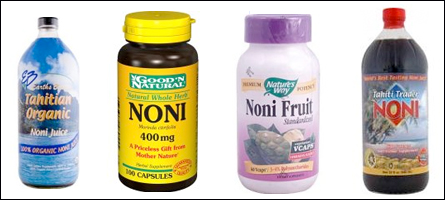 Products of Morinda citrifolia (Nu’naa in Tamil) marketed in the forms of juice, bottled fruit and capsules, under the name Noni in the Pacific Islands
Some related place names: Nu’naa: (Tamil) Nu’nu-vil: The pond of Nu’naa trees; Karaveddi East, Vadamaraadchi Southwest division, Jaffna district. Nu’nasai: The place of Nu’naa trees; Maathakal West, Maathakal, Jaffna district. The place name was coined as Nu’nasai perhaps to sound sacred about the place, as it has a famous Kanthasaami (Murukan) temple. Magncha-vanap-pathi: The place of the Magncha-nu’naa/ Magnchamunnaa jungle; Kokkuvil, Jaffna district. After building a Murukan temple at this place, to sound sacred, the name has been changed as Magncha-vanap-pathi. Ahu: (Sinhala) Ahu-gammana: The village extension or the cultivated country having Ahu trees; Mahara division, Gampaha district. Gammaanea: Cultivated country, inhabited country in the neighbourhood of a village (Sinhala) Ahun-gala: The rocky place or hillock of Ahu trees; Balapitiya division, Galle district Ahu-goda: The bank or hill of Ahu trees; Polgahawela division, Kurunegala district Ahi-vah/ Ahi-vah-kaa: (Dhevehi/ Maldivian) Ahivah-fushi: The island of Morinda citrifolia fruits; Maalhosmadulu South Atoll, Maldives. (An Etymological Dictionary of Maldivian Island Names) Ehivakaa: (The island of) Morinda citrifolia; Huvadhoo South Atoll, Maldives. (An Etymological Dictionary of Maldivian Island Names) Maa-ehivakaa: The big (island of) Morinda citrifolia; Huvadhoo South atoll, Maldives (An Etymological Dictionary of Maldivian Island Names) First published: Friday, 18 March 2011, 06:34
Previous columns:
|
Latest 15 Reports
|
||||
|
Reproduction of this news item is allowed when used without
any alterations to the contents and the source, TamilNet, is mentioned |
||||||
|
News | Features | Opinion | Palaka'ni | Photo Features | TN Transcription
Web feeds | Feedback | Home | About us |
 URL: http://www.tamilnet.com