


11.01.26 15:02 
Declaring and disabling: TNPF neutralises Tamil sovereignty, self-determination & referendum
Declaring and disabling: TNPF neutralises Tamil sovereignty, self-determination & referendum



|
|
Know the Etymology: 263
Place Name of the Day: Friday, 07 June 2013 Kirigal-poththa, Gal-pothu-goda, Wetake-potha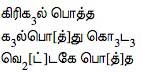 Kirigalpotta Galpotugoḍa Waeṭakēpota Kiri+gal+poththa Wætakea+potha The range/ surface/ mass of white rocks The rock surfaced hill or bank The range (surface cover) of screw pines
 A postal stamp showing Kirigal Poththa and its face of white rocks. [Image courtesy: stampopedia.com]
Kirigal-poththa is a well known mountain peak, the second highest in the island, rising to 7835 feet (2,388 m) at the boundary of the Nuwara Eliya and Ratnapura districts of the Central and Sabaragamuwa provinces.  The white rocks of Kirigal Poththa. [Image courtesy: Rehman Abubakr, Wikimedia Commons]
The popular place name components, Poththa (often written in Roman as Potta), Potha (without the double TH), Poatha and Pothu in Sinhala; Poththana in some recently Sinhalicised place names of North Central Province and Poththaanai in the Eezham Tamil place names of the East, are generically related, even though they are found used in different shades of meanings in different contexts. The Sinhala or Tamil dictionaries don’t provide the toponymic shades of meanings of these terms. Treating the phrase Gal-potta as one word, Clough’s Sinhala-English dictionary gives the meaning, “range or surface of rocks.” As Gal means stone or rock, it could be deduced that Potta in its geographical context means a range or surface. The Sinhala dictionary meanings of Potta alone are bark, husk and shell. Related Sinhala words, Potha means a cloth in general; Pothu means a mat-making grass or a shell; Podiya means a bundle, Poatha means the site of a dwelling house. When studied with the help of the large number of place names having the components, the meanings that could be deduced from the context are: a range of anything such as rock, grass or vegetation of a particular type of trees, shrubs, plants, creepers etc. that shield a terrain as a surface cover; a mass, and in some contexts when the spelling is Poatha, a shelter or a dwelling place. (See the list of related place names to get the full range of contexts) A cover or a spreading cover is the fundamental meaning of Poththa and all the related components. A careful comparison of the Sinhala cognates listed under the table Potta (Poththa) and the Dravidian cognates listed under the table Poththu (the Tamil verb, meaning ‘to cover’) would show the affinities on all the counts. The Sinhala cognates mean, bark, husk, shell, cloth, grass, bundle and site of dwelling place, and in the context of place names mean a range of a surface cover. The Dravidian cognates mean, cover, thick part of a jungle, bush, thicket, low jungle, grass, grove, thicket overgrown with grass, thick tuft of trees, to cover completely in a heap like shape, hill, outer garment, bark, garment of fibres, cloth, bundle, roof, secluded place, shelter and sleeping place for animals. A Comparative Dictionary of Indo-Aryan Languages has an entry for Poata/ Potta, meaning cloth in Sanskrit/ Prakrit/ Pali, but with a note on the probability of its Dravidian origins (CDIAL 8400). The Kiri prefix of Kirigal, meaning white, corresponds to its meaning milk, and is traced as a cognate of Kshreen in Sanskrit and Kheeri in Prakrit. Etymological discussions relating Gal and Goda to Dravidian could be found in the earlier columns. Wetake, written and pronounced as Wætakea in Sinhala, means screw pine. It is a phrase of two words, Wæta and Kea. Wæta means a hedge of fence. Screw pines normally grow as a hedge along rivers and backwaters. The etymology of Wæta/ Wata has been discussed under the column Wætiya. The other word Kea corresponds to Kaay in Tamil/ Dravidian, meaning a fruit (unripe, but a general term for the fruit of any plant). In Sinhala, Wætekea is also called Wætakeyiyaa. Making a comparison, banana, breadfruit and screw pine are called Keyo in Maldivian. Kirigal Poththa Mountain is in Ginigath-hena GS area of Ambagamuwa division of Nuwara Eliya district. The peak borders Nuwara Eliya and Ratnapura districts of Central and Sabaragamuwa provinces. There is another place bearing the same name, Kiri-gal-potta, which is a GS area in Matale division of Matale district. Gal-pothu-goda is in Dompe division, Gampaha district Wetake-potha ia a place in Delthota division, Kandy district. Some related place names: Potta (pronounced Poththa): Galpotta-vila: The pond in the rock surface/ range/ mass; Dodangoda division, Kalutara district Yati-galpotta: The lower range of rock or the rock surface/ mass at the bottom; Galewela division, Matale district Pottata-wela: The paddy field of the range or mass (of something); Laggala-Pallegama division, Matale district Dig-galpotta: The long or big range/ mass of rocks; Hanguranketha division, Nuwara Eliya district Galpotta-wala: The forest of the rock-range or rock-mass Karandeniya division, Galle district Galpotta-wela: The paddy field of the rock-range or rock mass; Pelmaddulla division, Ratnapura district. The place has a range of rock mass with a paddy field stretch adjacent to it Galpotta-yaaya: The expanse of the rocky surface/ rock mass; Weeraketiya division, Hambantota district Mella-potta: The range/ surface cover of Mælla trees; Wariyapola division, Kurunegala district Ura-potta: The hard mass covered with scrub vegetation; Bingriya division, Kurunegala district. This place has an expanse or range of scrubland along the river Deduru Oya where the river makes an elbow turn. Ura may mean shoulder (of the river), a species of Cassia vegetation (Ura’na), snake or hog in this context. Ura, Uraa: snake (Sinhala); Ooran: snake (Malayalam, DED 749); from Oor: (verb) to move slowly, creep, crawl as a snake (Tamil, DED 749) Dodam-potta: The range / surface cover of orange trees; Pannala division, Kurunegala district Koodalu-potta: The range/ surface cover of Koodalu-dehi (leech-lime) shrubs or Koodalu-mal (Impatiens flaccida) plants; The Pannala division, Kurunegala district Gorok-gaha-potta: The range/ surface cover of Goroka trees; Polgahawela division, Kurunegala district Kuree-potta: Polgahawela division, Kurunegala district Puran-potta: Probably, the range of wasteland of fallow land; Ruwanwella division, Kegalle district. Pura’na: Waste or fallow land (Sinhala) Potta-kanda: The range-hill/ the mass-hill/ the hill covered (by vegetation); Pelmadulla division, Ratnapura district Potha (written without the double TH): Bata-potha: The range (forest cover) of Bata (small species of bamboo) or the descending surface; Kaduwala division, Colombo district; Minuwangoda division, Gampaha district; Pannala division, Kurunegala district. Bata: also Batalee: small species of bamboo or bamboo cane, peculiar to Ceylon, Ochlandra strudula. Bata also is a prefix to the name of some other plants (Sinhala); Bata: slope, going down, a descent from a height, the west (Sinhala) Gurulu-potha: The range (surface cover) of Gurulla shrubs (Leea sambucina); Minipe division, Kandy district Rambuk-potha: The range (surface cover) of Rambuk cane; Medadumbara division, Kandy district; Badulla division, Badulla district Nattaram-potha: Kudasale division, Kandy district Degam-potha: The range of the twin villages; Weeraketiya division, Hambantota district Pala-potha: The range of the keeper or the dwelling place of the keeper; Belitta division, Hambantota district Diddeni-potha: The range of the big valley or flood plain; Mulatiyana division, Matara district Madu-potha: The range of the tank bed; Padiyathalawa division, Amparai district Ara-potha-gama: The village in the range of the river plain; Mahaoya division, Ampaa’rai district Ara-potha: The river plain; Mahaoya division, Ampaa’rai district Budara-potha-yaaya: The expanse of surface covered by Budara plant; Mahaoya division, Ampaa’rai district. Boo-tara’na: plant, variety of Webera corymbosa; Boo-toara: Cassia absus Katu-potha: The thorny range (surface cover of thorny plants); Ibbagamuwa division, Kurunegala district; Pallama division, Puththa’lam district Ul-katu-potha: The thorny range having a spring; Hinguragoda division, Polonnaruwa district. Ool: Spring, fountain (Sinhala); Oottu: Spring, fountain (Tamil) Nika-dalupotha: The new cultivation field of abundance; Ganewatta division, Kurunegala district. Nikaa: abundance (Sinhala). Dalupotha: a range of forest, grassland etc., recently brought under cultivation; Dalu: shooting, budding (Sinhala); Tha’lir: shoot, shooting leaves (Tamil) Vila-katu-potha: The thorny range of the pond; Bingiriya division, Kurunegala district Kurundu-potha: The range of Kurundu trees; Bingiriya division, Kurunegala district Dunu-potha: The old or decayed range; Katupotha division, Kurunegala district Dunu-potha-gama: The village in the old or decayed range; Nochchyagama division, Anuradhapura district. Du’nu: old, decayed (Sinhala); from Jeer’na Mas-potha: Probably, the range of Mas trees; Maspotha division, Kurunegala district; Rideegama division, Kurunegala district Maavee-dalupotha: The field recently brought under Maavee paddy cultivation; Kurunegala division, Kurunegala district Kahandaweli-potha: The range (surface cover) of Kaha-a’ndawæl plant (probably, Crotularia retusa or Cuscuta reflexa); Mawathagama division, Kurunegala district Thara-potha: The big range or dwelling place; Mawathagama division, Kurunegala district Metiyam-potha: Probably, the minister’s range of land, or dwelling place; Rideegama division, Kurunegala district. Poatha, with an elongated O, means the site of a dwelling place (Sinhala) Dalupotha-gama: The village of the range recently brought under paddy cultivation; Kuliyapitiya East, Kurunegala district Kurudel-potha: The range of a short variety of wild breadfruit trees; Kuliyapitiya West, Kurunegala district Thal-potha: The range of palmyra palms; Lankapura division, Polonnaruwa district Kesel-potha: The range of plantain crop; Rideemaliyadda division, Badulla district Mal-potha: The range of flowering plants; Welimada division, Badulla district Nika-potha: The range of Nika trees; Hildummulla division, Badulla district Alu-potha: The range of A’lu-gas plant (Alpinia alugas); Badalkumbura division, Moneragala district; Pelmadulla division, Ratnapura district Wasi-potha: The dwelling (settlement) range or the dwelling place; Badalkumbura division, Moneragala district Karadu-potha: The range (surface cover) of Karadu plants (Dracontium); Kegalle division, Kegalle district Eduru-potha: The teacher’s dwelling place or the exorcist’s dwelling place, or the rock-range; Galigamuwa division, Kegalle district. Æduru: Teacher, exorcist, messenger, rock, (Sinhala); If it is Poatha with an elongated O, the word means the site of a dwelling place (Sinhala) Uda-potha: The upper range; Bulathkohupitiya division, Kegalle district Wata-potha: The enclosed dwelling place; Nivithigala division, Ratnapura district Thitta-wel-potha: The range (surface cover) of Titta-wæl plants (Anamirta paniculata); Embilipitiya division, Ratnapura district Kailawel-pota: The range (surface cover) of Kayila-wæla creeping plant (Phylunthus reticulatus); Angunakolapelessa division, Hambantota district Maa-pota: The big range; Eheliyagoda division, Ratnapura district Diya-pota: The watery range; Embilipitiya division, Ratnapura district Pothu: Pothu-arawa: The stream or river grown with reed; or the stream of the range; Kaduwela division, Colombo district Gal-pothu-kanda: The hill covered by a rock surface or the hill of the rocky range; Katuwana division, Hambantota district Pothu-pitiya: The vegetation covered range of high ground; or the high ground or plain of reed or grass; Kalutara division, Kalutara district; Kalawana division, Ratnapura district Pothu-vil: The reed-pond; or the pond of the range; Pothuvil division, Ampaa’rai district Pothu-vila: The reed-pond; or the pond of the range; Beruwala division, Kalutara district; Polpithigama division, Kurunegala district; Ganewatta division, Kurunegala district; Madampe division, Puththa’lam district Pothu-wewa: The reed tank; or the tank of the range; Mahawa division, Kurunegala district Wel-pothu-wewa: The creeping reed tank; or the tank of the range of creepers; Kobeigane division, Kurunegala district Kirigal: Kirigala-hena: The shifting field of cultivation in the white rock locality; Horana division, Kalutara district Kirigal-wewa: The tank of the white rocks; Medawachchiya division, Anuradhapura district Kirigallewa: Kirigal-wewa: The tank of the white rocks; Kahatagasdigiliya division, Anuradhapura district Wa-kirigala: The white rocks of Waa (Cassia siamea) vegetation; Aranayaka division, Kegalle district First published: Friday, 07 June 2013, 22:58
Previous columns:
|
Latest 15 Reports
|
||||||||||||||||
|
Reproduction of this news item is allowed when used without
any alterations to the contents and the source, TamilNet, is mentioned |
||||||||||||||||||
|
News | Features | Opinion | Palaka'ni | Photo Features | TN Transcription
Web feeds | Feedback | Home | About us |
 URL: http://www.tamilnet.com