

11.01.26 15:02 
Declaring and disabling: TNPF neutralises Tamil sovereignty, self-determination & referendum
Declaring and disabling: TNPF neutralises Tamil sovereignty, self-determination & referendum



|
|
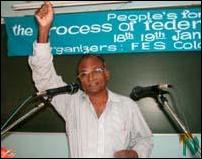
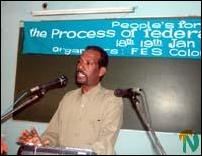
'Federalism will unite divided Sri Lanka' – Jaffna don[TamilNet, Sunday, 19 January 2003, 12:48 GMT]“This country is already divided. This is the ground reality. The Sinhalese people have to be told this. There is no point in talking about history now. The Indo-Lanka Accord, the Banda-Chelva Pact and the Dudley Chelva Pact have recognized the separate distinct identity of the Tamils in the past. The Sinhalese have to be told that the divided country can be united by granting a federal solution," said Prof. S. K Sittampalam, a senior historian, speaking at a seminar on ‘Federalizing the Sri Lankan State’ in the University of Jaffna Sunday.
Dr. Rohan Edirisingha, senior lecturer in law in the University of Colombo, stressed the need for understanding the nature of unitary and federal systems and their basic features. He said that there is a lot of ignorance among the Sinhala people about the federal system of regional autonomy and that much needs to be done to educate them on the matter. “Many of them think that it could be a stepping stone to separation," Dr. Edirisingha said. He appealed for greater dialogue between Tamil and Sinhala intellectuals and opinion makers on the federalism during his presentation on Saturday. “The southern polity is not prepared to accept Sri Lanka as a pluralist state. Therefore how do we ‘sell’ the idea of federalism to the (Sinhala) majority? Is there enough to get out of this ghetto mentality and accept Sri Lanka as a pluralist state?” asked Mr. V. T Thamilmaran, senior lecturer in law in the university of Colombo, in his presentation at the seminar Sunday.
“Internal self-determination should also guarantee territorial identity and strike a balance between the rights of individuals and the rights of a group, providing for a bill of rights charter in which special protection for the group should not be construed as a violation of the principle of equality," he added. Mr. Thamilmaran pointed out that Articles 2, 3, 4, 75, 76 and 82 of the Sri Lankan constitution preclude the possibility of setting up a constituent assembly to draft a new constitution for Sri Lanka. The two day seminar and workshop were supported by the Fredrich Ebert Stiftung Foundation (Germany) in Colombo.
|
Latest 15 Reports
|
||||
|
Reproduction of this news item is allowed when used without
any alterations to the contents and the source, TamilNet, is mentioned |
||||||
|
News | Features | Opinion | Palaka'ni | Photo Features | TN Transcription
Web feeds | Feedback | Home | About us |
 URL: http://www.tamilnet.com