Know the Etymology: 213
Place Name of the Day: Tuesday, 22 May 2012
Muruthawala, Muruththanai
முருத்தவல, முருத்தனை
Murutavala, MuruttaṉaiMurutha+vala
Muruthu+thanai
The jungle of Murutha trees
The place of Muruthu trees (Lagerstroemia flos reginae)
| Murutha |
A timber tree, Lagerstroemia flos-reginæ, bearing a beautiful flower (Sinhala); Murutha-mal: Flower of the Murutha tree, ruby (Sinhala); Poo-maruthu, also Kathali: The same tree, Lagerstroemia flos-reginæ (Tamil, Madras Tamil Lexicon); Ma’ni-muruthu, Neeru-muruthu: The same tree, Lagerstroemia flos-reginæ (Malayalam, Deccan Herald, 7 May 2012); Also Ma’ni-maruthu, Chem-maruthu, Poo-maruthu, Neer-maruthu: The same tree, Lagerstroemia flos-reginæ (Malayalam, R. Vasudevan Nayar, Controversial Drug Plants, 2004, p27); Maruva: The same timber tree, Lagerstroemia flos-reginæ (Kannada, DED 4721); Marva: The same tree, Lagerstroemia flos-reginæ (Tulu, DED, 4721); Maru (verb root), Maruvu: To combine, set (as a jewel), encase (Tamil, DED 4722); Mota-bondara, Taamha’n: Lagerstroemia flos-reginae (Marathi, The flower of the tree is the State Flower of Maharashtra); Jarul: Lagerstroemia flos-reginae (Hindi); Arjuna, Kramuka: Cited as Sanskrit names for Lagerstroemia flos-reginae, but misnomers as standard Sanskrit dictionaries do not give those names (Sanskrit English Dictionary, Monier –Williams, Vasudevan Nayar, ibid.); Aaru: Lagerstroemia Regina (Sanskrit Lexicons, Monier-Wiiliams)
|
| Wala |
Forest, jungle (Sinhala); Vallai: Extensive thicket, big forest (Tamil, DED 5289). See column on Vellaa-ve’li
|
| Thanai |
Place (Eezham Tamil place names); Thaanam: Place (Tamil); Taanea, Tana, Tan, Tena, Tæna,Tæan: Place, spot, site, locality, situation (Sinhala); Sthaana: Place (Sanskrit); Taana, Taa’na: Place (Pali/ Prakrits). See column on Naaraanthanai
|
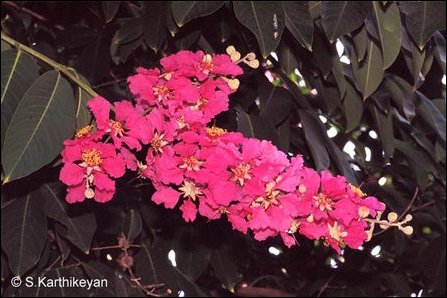
Lagerstroemia flos-reginae: Murutha (Sinhala) Ma'ni-muruthu (Malayalam) and Poo-maruthu (Tamil), flowering in pink [Image courtesy: S. Karthikeyan, Flowering Trees of Bangalore, wildwanderer.com]
Murutha in Sinhala, Poo-Maruthu in Tamil and Ma’ni-Muruthu in Malayalam that have rendered the place names such as Murutha-wala in Sinhala and Muruthanai in Eezham Tamil, are equated to the flowering timber tree, botanically known as Lagerstroemia flos-reginae of the Lythraceae family.
The tree is commonly called as Pride of India, Queen’s Flower Tree, Crape Flower Tree, Queen’s Crape Myrtle, etc., in English.
The name of the tree Murutha in Sinhala corresponds to Dravidian terms for the tree Muruthu (Malayalam), Maruthu (Tamil), Maruva (Kannada) and Marva (Tulu). The Dravidian terms are listed in Dravidian Etymological Dictionary (DED 4721), Madras Tamil Lexicon and in Malayalam usages. (See table)
The Indo-Aryan terms Kramuka (Sanskrit), Aaru (Sanskrit) and Jarul (Hindi) for the tree do not correspond to the Sinhala term.
Note that while the tem Murutha-mal in Sinhala stands for the flower (Mal: flower) of the Murutha tree as well as ruby, correspondingly in Malayalam the tree is referred to as Ma’ni-muruthu or Ma’ni-maruthu (Ma’ni means ruby).

A Lagerstroemia flos-reginae tree in blossom [Image courtesy: Dinesh Nayak M., Deccan Herald]
The tree bears beautiful flowers of pink colour, in bunches, looking like a set of gems (see images).
The verb root Maru/ Maruvu in Tamil has a shade of meaning to combine, encase or set as a jewel (DED 4722).
Kathali is another Tamil name for the tree, which also is connected to the meaning, bunches (Kadali: mass, multitude; Kannada, DED 1198).
A native of the hill tracts of South India and the island of Sri Lanka, the name of the tree is often confused in Sanskrit medicinal terminology (R. Vasudevan Nair, Controversial Drug Plants, 2004, p27).
In South India it grows naturally along the sides of streams in the Western Ghats. Note the Malayalam name Neer-muruthu (water-muruthu).

Purple flower of Lagerstroemia flos-reginae in detail [Image courtesy: ebay.com]
The tree normally grows up to 10 m in height, but in its natural habitats up to 20m. It flowers in pink, purple or mauve in 30 cm long panicles at the end of all the branches during spring (March-May) and the flowers stay for months. The tree is nowadays advocated to grow on roadsides and parks.
The valuable timber, hard and durable in water, is used in building boats and carts. (Dinesh Nayak, Pride of India, Deccan Herald)
Various parts of the tree are used in native medicine. The seeds narcotic, root astringent, leaves purgative, fruits are used for aphthae in the mouth and bark is used for abdominal pain.
The flower of the tree has been chosen as the state flower of Maharashtra in India. The Marathi name Mota-bondara is close to the Dravidian terms (Murutha > Mota).
Example for use of the tree name in Tamil literature:
“Ki’li va’lar poo-maruthu”
“கிளி வளர் பூ மருது” (சீவக சிந்தாமணி 1:35)
The flowering Maruthu where parrots dwell (Cheevaka Chinthaama’ni 1:35)

The variety of Lagerstroemia flos-reginae flowering in purple [Image courtesy: ebay.com]
The suffix Wala in the Sinhala place name means a forest. The word corresponds to Vallai of Dravidian etymology (DED 5289) in old Tamil, which means an extensive thicket or big forest. See column on
Vella-ve’li.
The suffix Thanai in the Eezham Tamil place name, meaning a place or locality, is of Indo-Aryan origin and is a cognate of Staana in Sanskrit, Taana in Prakrits and Taanea, Tana, Tan, Tena, Tæna and Tæan in Sinhala. See column on
Naaraanthanai.
* * * Murutha-wala is a place in Mawanella division of Kegalle district. There is another Murutha-wala in the Mirigama division of Gampaha district
Muruthanai is a place in the Koa’ra’laippattu division of Batticaloa district. This is a GS division close to Punaanai and Vadamunai
* * * Some related place names:Muruthana: The locality of Murutha trees; Katana division, Gampaha district
Murutha-gas-pitiya: The high ground of Murutha trees; Dehiattakandiya division, Ampaa’rai district
Murutha-gaha-mulla: The Murutha-tree corner; Udunuwara division, Kandy district
Murutha-watta: The grove of Murutha trees; Yatawatta division, Matale district
Murutha-gama: The village of Murutha trees; Hanwella division, Colombo district
Murutha-wela: The paddy fields in the locality of Murutha trees, or Murutha-wælla: The jungle of Murutha trees; Weeraketiya division, Hambantota district
Muruthawa: Probably, from Murutha-wala: The forst of Murutha trees; Ibbagamuwa division, Kurunegala district
Murutha-muraya: Probably, Murutha-muraja: Encircling of Murutha trees; Hakmana division, Matara district. Muraja: Encircling (Sinhala); Murai, Muraimai: Order, arrangement (Tamil, DED 5015).
Muruthu-kanda: The hill of Murutha trees; Buttala division, Moneragala district. This is a hill of 1805 metres altitude.
First published: Tuesday, 22 May 2012, 01:07
Previous columns:



 Ma'ni-muruthu (Malayalam) and Poo-maruthu (Tamil), flowering in pink [Image courtesy: S. Karthikeyan, Flowering Trees of Bangalore, wildwanderer.com])


 URL: http://www.tamilnet.com